Fine motor activities for 3- and 4-year-olds
Fine motor skills are the small, precise movements of the hands and fingers: what kids use to hold a pencil, button a shirt, cut with scissors and draw. At 3 and 4, they practice them by playing, with things you already have at home. Here are 12 activities, what to expect at each age, and the safety tips that apply to all of them.
What fine motor skills are
They are the small, precise movements of the hands and fingers, usually together with the eyes. Kids use them to pick up a paper ball with their fingertips, turn the page of a book, button a shirt, cut and hold a pencil. Gross motor skills are the big movements, like running, jumping and climbing, and kids practice both together when they play.
What to expect at 3 and 4
Every child has their own pace, and these milestones are a guide, not a test. The CDC, the U.S. Centers for Disease Control and Prevention, lists what most children, 75% or more, can do by each age.
- By 3: string items together, like large beads or macaroni; use a fork; draw a circle when you show them how.
- By 4: hold a crayon or pencil between the fingers and thumb, not in a fist; unbutton some buttons; serve themselves food or pour water, with an adult watching; draw a person with three or more body parts.
If your child isn't doing something on the list yet, watch for a week or two, offer games that call for that movement and, if you're still unsure, talk to your pediatrician.
12 activities to do at home
Almost everything uses what you already have. It doesn't take long: ten minutes is already a good game, and it's best to stop while your child is still having fun.
Play dough
Make balls, snakes and cookies; squeeze, pinch, roll and cut with a plastic knife. It exercises hand strength and the finger pinch.
Clothespins
Clip clothespins around the edge of a box, a cup or a paper plate, which turns into a sun or a lion's mane. Squeezing a clothespin exercises the pinch between the thumb and index finger.
Tear and paste paper
Tear strips of magazine or colored paper and paste them into a picture. To tear, each hand makes a different movement, and that alone is practice.
String macaroni or big beads
String tube pasta, like penne, or big beads on a shoelace, which has a stiff tip. It's one of the CDC milestones for age 3. Use big pieces and stay close.
Move things with tongs or a spoon
Move pom-poms or paper balls from one bowl to another with kitchen tongs, salad tongs or a spoon. It exercises precision and eye-hand coordination.
Cut with blunt-tip scissors
Start with narrow strips, which take a single snip, then follow a straight line drawn on the paper. Always with kid-safe, blunt-tip scissors and a grown-up nearby.
Draw with crayons and markers
Free drawing on a big sheet taped to the table, so the paper doesn't slide. Chunky crayons and thick markers are good to start with.
Paint with a brush and fingers
Washable paint with a thick brush, a sponge or fingers. Painting inside a big shape, like a circle or a fish, asks for control without demanding perfection.
Paths and mazes
Draw wide roads, a spiral or a simple maze for your child to follow with a finger and then with a pencil, staying on the track. It's the line control writing will need later (see the guide on first letters).
Buttons, zippers and lids
Unbutton big buttons (a CDC milestone for age 4), open and close zippers, twist jar lids, put on socks. Everyday tasks count too.
Fold paper
Fold a sheet in half, make a fan or a simple boat. Lining up the corners asks for precision and focus.
Draw on paper with the phone as a guide
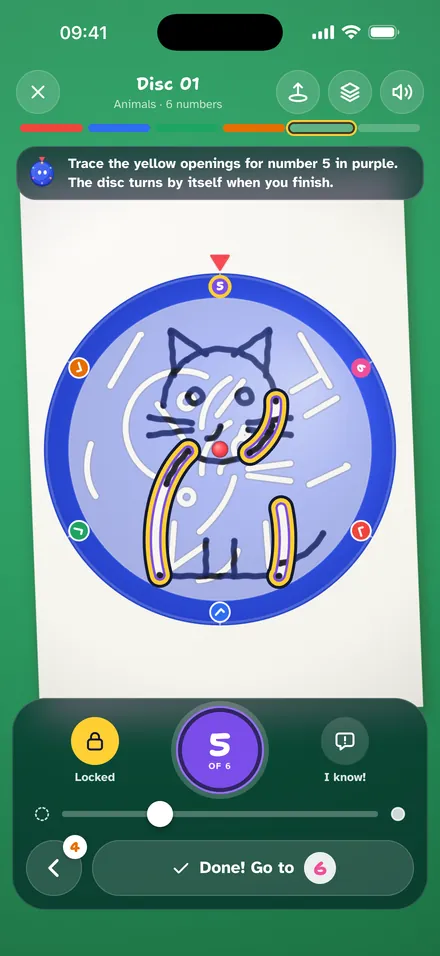
In Disco Draws' On paper mode, the phone sits about 30 cm (12 in) above a white sheet, and the screen shows a disc over the paper. Kids trace the openings for one number at a time with a marker; when the camera sees the line, the disc turns to the next number. At the end, the drawing is on the paper, and only then do kids find out what they drew. It practices line control, focus and number order.
1
Number 1
12
Numbers 1 and 2
1234
All numbers
It's a cat!
What about screens?
On a screen, kids color with a finger, without holding anything; the pinch and the strength to hold a pencil come from a real pencil. The World Health Organization recommends no sedentary screen time for children under 2 and, from 2 to 4, no more than 1 hour a day; less is better.
In Disco Draws, On paper mode brings the two together: the screen shows the way, but the line is drawn with a marker on real paper. And in the Parents area, you can see how long your child played today and set a daily limit.
Safety tips for every activity
- Small parts: beads, buttons, bottle caps and beans can be swallowed or put in the nose or ears. Use big pieces, put everything away afterwards and stay close the whole time. In the U.S., toys with small parts can't be sold for children under 3.
- Supplies: choose crayons, paint and play dough labeled non-toxic.
- Scissors: only kid-safe, blunt-tip ones, with a grown-up nearby.
- Pace: short sessions, stop before your child gets tired, and praise the effort, not the result.
- The favorite hand: let your child choose which hand to draw with; left-handed kids don't need to be corrected.
Frequently asked questions
What are fine motor skills?
The small, precise movements of the hands and fingers, usually together with the eyes. Kids use them to hold a pencil, cut, button a shirt and turn the page of a book.
What fine motor activities can I do with a 3-year-old?
Play dough, clothespins, tearing and pasting paper, stringing macaroni or big beads on a shoelace, drawing with crayons and finger painting. Always with a grown-up nearby, because of small parts.
And with a 4-year-old?
The same, plus cutting with blunt-tip scissors, following paths and mazes with a pencil, folding paper, and buttoning and unbuttoning clothes. By 4, most kids hold a crayon or pencil between the fingers and thumb, according to the CDC.
How much time a day?
There's no set number. Fit play into the day: a few minutes of play dough, a drawing, and everyday tasks like opening jars, putting on socks and pouring water.
Do phone games help fine motor skills?
On a screen, kids color with a finger, without holding anything; the pinch and the strength to hold a pencil come from a real pencil. That's why Disco Draws' On paper mode has kids draw with a marker on a sheet, with the phone only showing the way. The WHO recommends no more than 1 hour of sedentary screen time a day from 2 to 4.
When should I talk to the pediatrician?
If your child isn't doing things most kids their age do, has lost skills they once had, or if something worries you. Don't wait: the CDC milestone checklists can help the conversation.