First letters: how to help your child write their name
Their own name is often one of the first words kids want to write: it's theirs, and it's on their backpack, their bedroom door and their drawings. Writing asks for two things at once: the hand controlling the line and the mind understanding that letters stand for sounds. Here's what to expect from 3 to 6, how to show where each letter starts, and ten games to play at home.
When kids start writing
Every child has their own pace, and writing comes after a lot of scribbling. The CDC, the U.S. Centers for Disease Control and Prevention, lists what most children, 75% or more, can do by each age:
- By 4: hold a crayon or pencil between the fingers and thumb, not in a fist, and draw a person with three or more body parts.
- By 5: write some letters in their name and name some letters when you point to them.
Emilia Ferreiro and Ana Teberosky's research on how children learn to write showed that, long before they read, kids form their own ideas about writing: they use the letters they know, make up others, and may think the name of something big needs more letters. That isn't a mistake; it's part of the path.
Before letters, lines
Every print letter is made of a few strokes: the standing line, the lying line, the slanted line, the curve and the circle. A child who already makes these strokes with control is halfway there. Play dough, clothespins, paths and mazes help get the hand ready; they're in the guide to fine motor activities.
How to show a letter
- Start with their name in uppercase print letters, made of straight lines and curves only. Write it big on a sheet and keep it in sight.
- Show where it starts. Most letters start at the top. Draw a dot at the starting point and a little arrow where the line goes.
- One letter at a time: first the first letter of the name, then the others.
- Do it together: your child traces over your line, then copies it next to it and, finally, tries alone.
- Praise the attempt. Wobbly letters, letters that are too big, and backwards (mirrored) letters are common at the beginning.
- Use the school's style. If your child's school uses a particular letter style, use the same one at home.
10 letter games
Letters are learned with the whole body too, far from worksheets. A few minutes, when your child feels like it, is already a good game.
Letters in flour
Spread flour, salt or sand on a tray and write with a finger. To erase, just shake the tray.
Letters in the air and on backs
Draw the letter in the air, really big, with the whole arm. Then take turns drawing on each other's back and guessing the letter.
Play dough letters
Roll play dough snakes and shape the letters of the name on top of a model written on paper.
Letter hunt
Look for the letters of the name on packages, magazines and signs. Cut out the ones you find and paste them in the name's order.
Paint with water
With a brush and a cup of water, write big letters on the sidewalk or a fence. The letter disappears as it dries, and you can do it again.
Trace the dots
Write the name in dots with a starting dot on each letter, and let your child trace over it with a marker.
Body letters
Stand straight for an I, open your arms for a T, make an O with your arms over your head. Take photos and put the name together.
Magnetic letters
Build the name with magnetic, foam or paper letters, then write it next to them, looking at the model.
Their name everywhere
Write your child's name on their drawings, cup and backpack, and read it together, pointing: "this says your name".
Write the drawing's name
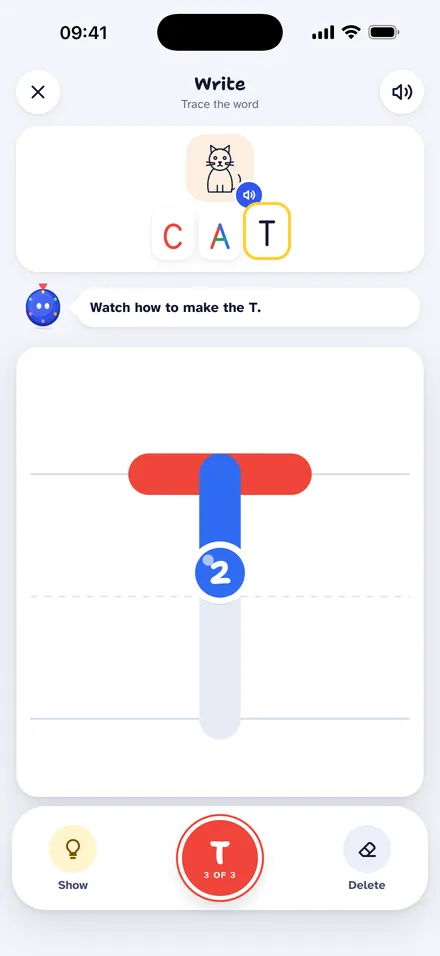
In Disco Draws, after discovering the hidden drawing, kids write its name, on screen or on paper. A dot shows where to start and the path of each stroke, and there are 3 levels of help: just the first letter, the word with the path of each letter, or the word with no path. The level comes from the child's age, and a grown-up can change it in the Parents area. On paper, the camera follows each letter.
What you don't need to push
- Perfection: the size and shape of letters settle in with time.
- The "right" hand: left-handed kids don't need to be corrected.
- Whole worksheets: a few minutes, when your child feels like it, are easier to keep up than a page of repetition.
- Hurry: every child has their own pace. If something worries you, like your child avoiding any pencil activity, talk to your pediatrician and to the school.
Frequently asked questions
At what age do kids write their own name?
Every child has their own pace. According to the CDC, by 5 most kids write some letters in their name. Before that, scribbles, made-up letters and writing their own way are all part of the path.
Where to start: uppercase or lowercase?
Uppercase print letters are the simplest to start with: they're made of straight lines and curves only, and they're the ones kids see most on signs and packages. If your child's school uses another style, follow the school.
My child writes letters backwards. Is that normal?
Mirrored letters, turned the other way, are common when kids start writing. Show again where the letter starts and where it goes, without making it a scolding. If you're still unsure after a while, talk to the school.
Should I correct mistakes?
Show how to make it once more, doing it together, and praise the attempt. Correcting every letter is tiring and can take away the wish to write.
Do apps help kids learn to write?
An app can show the path of each letter and make kids want to try, but pencil on paper still matters. In Disco Draws, kids can also write the drawing's name on paper, with the camera following each letter.
When should I ask for help?
If your child avoids any pencil activity, has a lot of trouble holding a pencil after age 4, or if something worries you, talk to your pediatrician and to the school.
Sources
- CDC: milestones by 4 years
- CDC: milestones by 5 years
- Ferreiro, E., & Teberosky, A. (1982). Literacy before schooling. Exeter, NH: Heinemann